Showing posts with label CPlan. Show all posts

Thursday, 15 August 2019

Collecting and monitoring the changes in my teaching


Describe how you will collect information about the implementation of your changed practices/intervention (so it is clear what you doing differently)

I plan to collect information about the implementation of changes through my weekly planning and highlighted in tables like the one below. 

Here is a detailed description of the changes I made in my teaching practice. 

One of the major mind-set changes for me as a teacher was EXPECTATIONS! I had no expectation what so ever for any student in this group to make much/if any shift at all. This was from reading their history of learning in their black folders which you get the general picture that this group of students had a negative outlook on their reading capabilities and actually hated reading time. I simply wanted them to enjoy reading. Feel good about themselves when they read. I have since lifted my expectations for this group by setting goals for us to work towards within a given time-frame. These goals are covered in my previous blog post about Interventions in Action.

My evidence of this change will be in my planning as my DATs (deliberate acts of teaching) will have less description of sequencing of lesson (coverage) and describing follow-up activity but more bullet points of important phrases and vocabulary I want to draw their attention to in a text.

Together with my "feelings" of how I think things are going, I have also collected a few student voice opinions every 3-4 weeks. I have also made sure to stick to my timeline for when I had planned to test students again. 

Here are my target groups mid-term 3 running records testing.

My 2 students I'd like to comment about are the ones of didn't make much/if any shift the first time round. My first student 'FM' only made 1 level shift in the previous testing round failing level 9. This time he round he passed level 9 and 10 so could potentially keep being tested up. Student 'GW' failed his level 15 test in term 2. This time, he passed level 15 and 16 and was quite chuffed with himself. My last student 'RF', although she is not getting the same change in teaching as she has moved reading groups, I can report she has made another 6months progress in her reading age. However this is not attributed to my interventions as she moved group at the start of Term 3. 

Thursday, 25 July 2019

Hypothesis 2 & 4 - Interventions in action

Term 3 started by revealing new reading groups and explaining why the changes were made and the challenge was made for others to monitor their own reading so they could see their progress - especially my target students who were still tracking along the colour wheel.

As a result from running records last term, one of my target students has moved out of the target group into the next reading group up. I haven't quite figured out how I will ensure the same interventions used with the group will be used in her new group but I will endeavour to sort that out next week. 

Here is my collated data for Hypothesis #2: Student voice. This also includes our goal setting talk which links with Hypothesis #4: High expectations. 
One of my highlights from this one-on-one session was students were able to say what they were good at and what they needed help with. I could also see that students struggled with spelling and they saw this as a barrier in their writing. 

They also completed a quick sight word test.

My goal for this term is to make the students learning visible. Only 3 or 4 students have shown they are able to select the best part of their learning/task to share onto their blog. My aim is to up-skill everyone in the group with the skills to share from 'explain everything' and then write a short description about their learning to accompany this.

Thursday, 28 September 2017

CoL Inquiry - CREATE checklist

Organising my blog posts into our Manaiakalani Teaching as Inquiry Framework has enabled me to identify the gaps in my inquiry which I have not addressed. The table below clearly identifies this for me as being the Create - Innovate part of our inquiry cycle.

Create - Innovate: 
Are we capitalising on the affordances of the technology to support the Five Affordances of Learn Create Share (Engagement, Teaching Conversations, Visibility, Cognitive Challenge, Scaffolding) identified by the WFRC

Reflecting back on my inquiry, I can confidently say these things have been happening and overlap with some of my other topics discussed in my blog posts under the label "Ctry" - try new things. So I will try and distinguish the differences between the 2 labels next time and be more specific to ensure I cover this aspect of the framework.


Make a plan
What can I already do and  what do I need help with?
Who are the learners? Group/class
What are the goals for my practice and student achievement?
Set up processes for capturing evidence about whether the strategies are working for my students.


Try new things
It is a constant state of action, monitoring, reflection, and adjustment - and then more action.
Failure may occur.
Feedback from learners - how will I engage them with new learning? Do they know we’re trying something new?  


Innovate
Are we capitalising on the affordances of the technology to support the Five Affordances of Learn Create Share (Engagement, Teaching Conversations, Visibility, Cognitive Challenge, Scaffolding) identified by the WFRC

Implement
Just do it!
Reflect
“Inquiry into the teaching–learning relationship goes hand in hand with formative assessment, in the cyclical evaluation process that goes on moment by moment, day by day, and over the longer term.” Assessment-in-the-classroom/Teaching-as-inquiry

Friday, 28 July 2017

Teaching as Inquiry Framework

We are now half way through the year. In our first CoL meeting of Term 3, one of our first tasks was to take a look at our progress so far in terms of where we are in the teaching as inquiry framework. Here is what I used to organise my thoughts when I shared with my inquiry group.

Thursday, 1 June 2017

CoL - Create: Make a plan

Create - Teaching Inquiry - "What strategies (evidence-based) are most likely to help my students learn?"
Make a plan
  1. What can I already do and  what do I need help with?
  2. Who are the learners? Group/class 
  3. What are the goals for my practice and student achievement?
  4. Set up processes for capturing evidence about whether the strategies are working for my students.
1. Upon reflection on the 'Learn' stages of our inquiry framework, I have identified what I can already do and what I need help with.

What I can already do:
  • Gather observation notes and use these to make informed decisions about my teaching
  • Target specifically identified learning needs
  • PD around 'create' pedagogy and activities has been most helpful!

What I need help with/ What I need to put in place:
  • Balancing between my planning and conveying my vision to my student teacher who has full control of my class for 2 weeks.
  • Organisation - having the technology available and ready to go. Eg: cameras & ipads charged.
  • Building up my 'bank of resources' for create activities that can be used for different activities.
2 & 3 -  Who are my learners? What are the goals for my practice and student achievement?
Initially, I started off targeting and monitoring just my priority learners, but upon reflection, I realised my inquiry included the class as a whole. I've also clarified what my inquiry is focusing on and where it sits in our Achievement Challenge matrix. The Achievement Challenge I am focusing on (number 4) focuses on making sure our Year 7-10 learners accelerate, rather than slide down from Year 6. Years of data have shown the students improving steadily from Years 1-6, then start to plateau and slip from Years 7-10. So ultimately, this is my end goal - to accelerate my Year 7 and 8 learners to show sufficient shifts in their learning.

4. Setting up processes for gathering evidence: For this I need to be more consistent in my reflections to ensure I cover week to week happenings with my learners. Also checking student blogs more regularly to see how they are describing their learning. Does this align with your desired outcome? I have also started the practice of gathering students on the mat for plenary sessions at the end of every lesson. We could discuss as a class what we found difficult, gave students a chance to explain some of the new learning they were proud of and for me to hear how students felt the lesson went.   

Wednesday, 31 May 2017

PD - Creativity Empowers Learning

Monday's staff PD was filled with Ooohs and Ahhhs as we watched the caliber of movie making Pt England had 10+ years ago. Our wonderful Dorothy Burt conducted our PD on how 'Creativity Empowers Learning'. Teachers who's work was shown shared their learning process and how they made those 'create' activities possible, but most importantly, the learning and motivation (engagement) students received while carrying out these tasks as part of their learning. 
This was great for us teachers who have only been here at Pt England a few year to see the types of activities and learning that can be had through movie making and animations. At times during my teaching here, I have been guilty of making my create activities a writing task or creating something with no real purpose or learning behind it. 

But with the start of my CoL inquiry at the start of this year, I have been more mindful and purposefully provided time in my class for students to be creative in their learning through the use of animations, acting, song and dance. This PD has helped me think of new ways to make this a part of students' learning and the pedagogy behind it has strengthened my resolve to ensuring this is happening daily for my learners.

Dorothy emphasised how Create is a DOING word which uses multiple sense and involves the use of your WHOLE BODY not just your brain.
SISOMO - Sight, Sound, Motion. This is what create is all about!

One of the excerpts shared from the Create part of the Learn Create Share Pedagogy was:

"One of the foundation goals of the Manaiakalani Programme is to 'motivate our learners to engage with the curriculum' and a significant driver for engagement has been our intentional use of modern technologies to enable creativity to play a significant part in learning and teaching opportunities."

It was great having this in front of us as a reminder that we have the same vision and are on this journey together. 

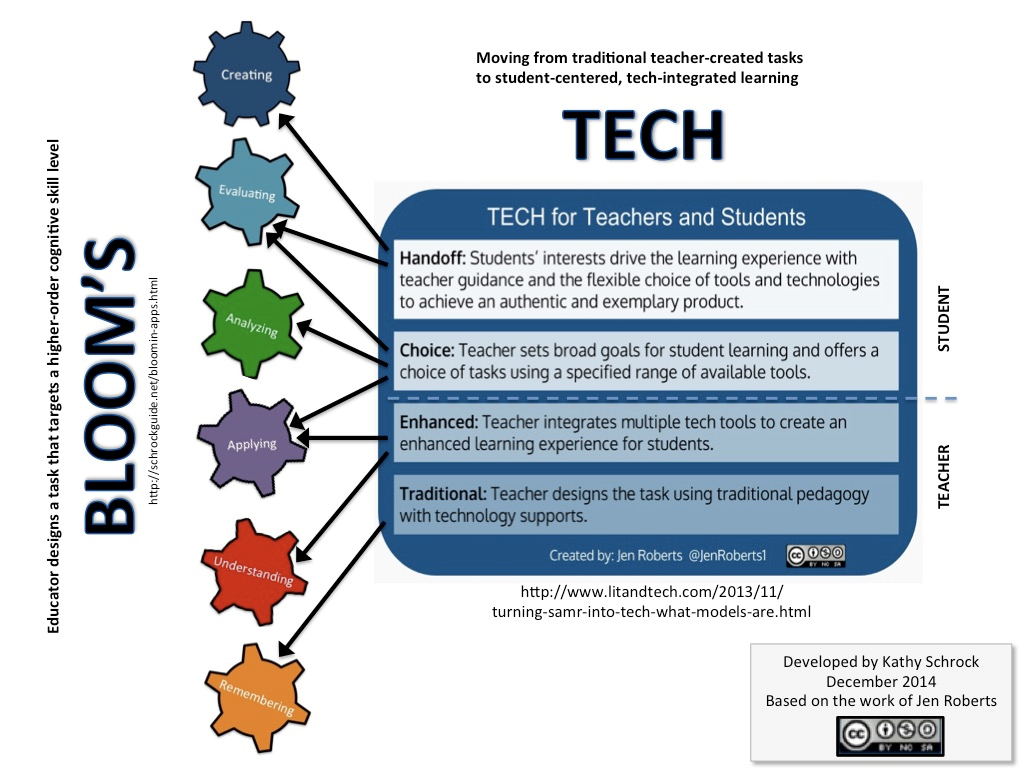
One of the slides I really liked and will hopefully talk about more in a later post is this one aligning Blooms Taxonomy with a SAMR type graphic, using TECH - moving from traditional teacher-created tasks to student-centered, tech-integrated learning.

Thursday, 9 February 2017

Teaching as Inquiry 2017

“Recognising and spreading sophisticated pedagogical practice across our community so that students learn in better and more powerful ways...”

The Manaiakalani Community of Learning is working together on this task using the expertise existing in of our community of learning.

In 2017 for my inquiry I have selected the following CoL achievement challenge: 


#4. Increase the achievement of Years 1-10 learners, with a focus on Years 7-10,  in maths, as measured against National Standards and agreed targets. My focus question is:
How can I accelerate students learning in maths through the teaching of number knowledge within a Learn, Create, Share pedagogy? 

The teaching as inquiry framework I will be using in 2017 has been specifically co-constructed for Manaiakalani schools using our familiar Learn Create Share structure.
The elements in this framework share close similarities with other models New Zealand teachers use.


I will be labelling my posts as I update my inquiry throughout the year to make the content easy to access.

Labels:
LEvidence, LScan, LTrend, LHypothesise, LResearch, LReflect,
 CPlan, CTry, CInnovate, CImplement, CReflect,
SPublish, SCoteach, SModel, SGuide, SFback, SReflect

Label Key:


LEvidence
Learn - Gather Evidence
CPlan
Create - Make a plan
SPublish
Share - Publish
LScan
Learn - Scan
CTry
Create - Try new things
SCoteach
Share - Co-teach
LTrend
Learn - Identify Trends
CInnovate
Create - Innovate
SModel
Share - Model
LHypothesise
Learn - Hypothesise
CImplement
Create - Implement
SGuide
Share - Guide
LResearch
Learn - Research
CReflect
Create - Reflect
SFback
Share - Feedback
LReflect
Learn - Reflect


SReflect
Share - Reflect