For each of your hypotheses, explain how you will test it and what evidence would support (or refute) that hypothesis.
Here is a plan for how I will test out each hypothesis giving a before and after 'snapshot'.
Hypothesis 1: Vocab and Comprehension:
My evidence to best show this would be a combination of my teacher planning in the DATs section (Deliberate Acts of Teaching) and the reflection notes describing how the group discussions went around vocab. Also students follow-up tasks on their blog. If students are able to explain that their learning was about the vocab found in texts rather than what the story was about.
Hypothesis 2: Student Voice
Evidence for this would be collecting student voice surveys from each Term as the year goes on. I'll also be looking at my reflection notes to see who/how many students I get to see 1-1 each week.
Hypothesis 3: Being Test Ready (Scaffolding)
I've put scaffolding in brackets as I feel it is the taking away of the materials students are using in their learning which will give an indication as to how well they can cope with learning without all the gadgets. As I haven't done much prep work this time round for running records testing, I can compare behaviours during testing - without any preparation around what to expect when you get tested - to later on in the year and format lessons so students know what to expect.
Hypothesis 4: High Expectations
The best way to try this out would be from our goal setting at the start of each term. From the goals we set at the start of the term, I will test to see who has made shifts and who hasn't. From there I'll evaluate and reflect on whether the expectations were too high, and if so, what's a smaller step we can aim for that's not reading age related but maybe more towards vocabulary.
Showing posts with label LResearch. Show all posts
Showing posts with label LResearch. Show all posts
Thursday, 30 May 2019

Thursday, 23 May 2019
Most Test Worthy Hypotheses
Explain the hypotheses about teaching that you decided were MOST worth testing, and why.
'' For students truly to be able to take responsibility for their learning, both teacher and students need to be very clear about what is being learnt, and how they should go about it. When learning and the path towards it are clear, research shows that there are a number of important shifts for students. Their motivation improves, they stay on-task, their behaviour improves and they are able to take more responsibility for their learning. ''
'' For students truly to be able to take responsibility for their learning, both teacher and students need to be very clear about what is being learnt, and how they should go about it. When learning and the path towards it are clear, research shows that there are a number of important shifts for students. Their motivation improves, they stay on-task, their behaviour improves and they are able to take more responsibility for their learning. ''
Absolum, M. (2006). 'Clarity in the Classroom'.
“Effective teachers inquire into the relationship between what they do and what happens for students (outcomes). But effective teachers do more than simply inquire (or reflect) – they take action to improve the outcomes for students and continue to inquire into the value of these interventions.”
(Aitken, 2010)
In delving deeper into this inquiry, I've realised there are so many factors and points I would like to cover in order to get my students into the right head space where they can take responsibility for their own learning, and my role in helping them get to that place. Here are a list of hypotheses I have decided (based on learning conversations around the school) are MOST test worthy and beneficial for my learners at the present time.
Hypothesis 1: Vocab vs Comprehension
Should I be focusing more on vocab rather than comprehension? Based on observation and testing so far, generating general conversation about a text has been difficult at times because the reading hasn't been fluent enough. Decoding is a bit of a stutter so the understanding of words hasn't been too clear. I believe although they are Year 7/8 students, a focus on vocabulary and letter sounds would more beneficial not just for their reading but also for writing. This hypotheses has come about through my observations with Helen Squires, specialised spelling test from Donna Ryan.
Hypothesis 2: Student voice
Am I checking in enough 1-1 with students? Am I listening to what they have to say about their learning? What I have found so far in my random 1-1 sessions is they become more switched on after their talks with me. They pay more attention and I guess they start to feel like they've been listened to. Doing more of this during a term would benefit students in my target group especially because they already have poor attendance and some have been identified as having behavioural issues.
Hypothesis 3: Being 'Test' Ready (Scaffolding)
Am I setting students up to be 'test ready' in Year 7/8 standardised testing situations? With iPads and using voice typing, and all the specialised scaffolding students are needing in order understand what they are learning about. None of these are on hand to use during normal standardised testing. Am I setting them up to be test ready?
Hypothesis 4: High Expectations
Are my expectations of my target group high enough? Or is it too high? Keeping in mind that these students have been at school for 6-7 years already and are still reading at 5.9years - 7.5 years reading age. Is a jump from 6years to 6.5years in a term too high of an expectation?
Thursday, 16 May 2019
What I read & who I talked to...
The latest task in our inquiry process is to develop a set of hypotheses about patterns in my teaching that could be changed or more effectively address the student learning focus.
The first part of this is:
Describe your process for developing hypotheses (what you read, who you talked with).
Learning Conversations with Colleagues
One of the starting points for this process would definitely be the sharing time in our team meetings where we share our success stories and things that have been going well in class. We also share our struggles and areas in reading which we need help with. Being in a team with a wealth of knowledge is great as everyone has gems and pointers to try out in class to help cater to some of the struggles with our learners.
Conversations with CoL Across Schools Teachers
I've had really informative discussions with 2 across schools teachers each time I've booked in with them. Clarelle Caruthers has helped with iPad activities using Explain Everything. Donna Ryan has also been helpful with her knowledge of assessments for students who barely register a mark on standardised tests for Year 7/8 students.
1-1 conversations with students in target group
Some of my release time on Thursdays have been used to have discussions with the learners in my target or focus group. The aim of these discussions is just to check in with them in regards to their whole well-being. Are they getting enough sleep, is there something we can do to help them get to school on time and everyday, do they need lunch, what are they struggling with in class (can be other classes) and share some of their success with things they've shared on their blog.
Teacher Observations: Agility with Sounds with Helen Squires
I was fortunate to be able to observe Helen take a group through Betsy Sewell's program 'Agility with Sounds'. Definitely made me see some of the gaps my learners have being catered to through this program. Here are some notes taken from that session. Thank you Hannah West for taking notes.
Professional Reading: Here are a few readings I've looked into in my 'delving deeper' phase of this inquiry. I have chosen these mainly from recommendations from others and colleagues directing me to where I could find more information about how to cater to my learners needs better. Also I wanted to find out about my own practice - am I being explicit enough, or pitching and planning work at the right level for my learners?
1. What every primary school teacher should know about vocabulary - Jannie van Hees and Paul Nation
2. Teaching ESL/EFL Reading and Writing - I. S. P. Nation
3. Clarity in the classroom - Michael Absolum
4. ESOL online - https://esolonline.tki.org.nz/
Thursday, 2 May 2019
Preliminary findings - Part 2
This term I have continued my quest for collecting data and evidence (Preliminary findings - part 1) to show in clearer detail the nature or extent of the student challenge.

One of the things I'd mentioned in the Tools, Measures and Approaches blog post was that I would seek help from CoL across schools teachers for more ideas on how I can get a clearer picture for what my target group CAN do.
So in the holidays I booked a time with Donna Ryan from Sommerville Special School. I shared with her my struggles with pinpointing exactly what my students were struggling with in reading. One of the things she gave me was a spelling test which, when analysed, could give you a better idea if it is letter-sound problems, phonics or something else they are struggling with. Donna has also offered to come into my class in Week 2 this term to test these students and see if she can pick up any other learning behaviours I haven't been able to identify.
The following are the spelling test for 7 out of 8 students. 1 of my students in this target group has been absent all week so far. This is a common pattern for him but I am still keen to keep him on as a target student.

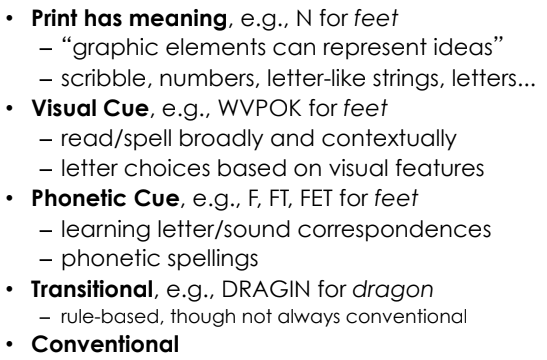
The different stages for this Development Spelling Word List (Ferroli & Shanahan 1987)
are below:
Upon analysing this, I have an almost overwhelming feeling of helplessness for these students. I can't even begin to imagine how hard things must be for them in class, especially during whole class teaching, when they struggle to make connections between letters and sounds. This then moves onto putting letters (and sounds) together to form actual words.
Despite my feelings about this, this target group of students are quite up-beat about their learning. They are definitely enjoying the activities and realisation that learning can be fun!
My next steps will be to see how the testing with Donna goes next week and go from there. Running records will also be starting soon and I'll be reporting on how that goes in a few weeks time.
Monday, 29 May 2017
Success Criteria & Self-assessment
As a continuation of 'where to next' in my inquiry, I have been focusing the past 2 weeks on the Learn-Scan part of our inquiry framework as this is where I had gaps.

This 'scan' area looked at how engaged students are with their learning. Can they articulate what they are learning about? Can they monitor their learning? Do they know what their next learning steps are?
To help me with this was the Assessment for Learning power point on TKI

Above is one the slides I found most useful and made me reflect on my classroom environment and how well I communicate with students how they are doing in their learning. Some of the things I felt I did well were:
- Creating a learning environment in my classroom
- Using assessment information to feed back into teaching
- Provide timely focused feedback
Some of the things I needed more work on were:
- Co-constructing clear learning goals with students
- Involve students in self and peer assessment
- Clarify learning outcomes with students.
Upon reflection, it prompted one of the readings from Michael Absolums' book 'Clarity in the Classroom' (2006).
"For students truly to be able to take responsibility for their learning, both teacher and students need to be very clear about what is being learnt, and how they should go about it. When learning and the paths towards it are clear, research shows that there are a number of important shifts for students. Their motivation improves, they stay on-task, their behaviour improves and they are able to take more responsibility for their learning."
From this, I focused students in on Success Criteria's. HOW will you know you have achieved the learning intention? So as I worked with each group, we broke down the learning intention and worked out what this will look like. Our discussions around the success criteria as a group gave me insight into whether or not students actually understood what learning was expected from the learning intention. It was great being able to co-construct the success criteria with each group. We tried to make it very specific so it was easy to self-assess. Here is an example of our final outcome for one group.
Example:
WALT (We Are Learning To): Interpret information from a pie and bar graph
Success Criteria: I will know I have achieved this when:
- I can say what the x and y axis show
- I can give 2 facts from each graph
Thursday, 18 May 2017
CoL inquiry - LEARN checklist
During our first CoL meeting for Term 2 we were introduced to a new Inquiry Framework. It followed our Learn, Create, Share pedagogy and so I have made a summary page for the 'Learn' part and matched it up with my inquiry posts in Term 1. This is focussing the inquiry - "What is important? (and therefore worth spending time on) given where my students are at?"
As you can see, one of the areas I need to work on is 'Scan' - what outside factors are contributing to students not being able to retain number knowledge well in their heads.
This term, I will looking at the 'Share' part of our framework.
Gather evidence
|
Student achievement data eg. standardised tests, OTJs, internals and externals
Anecdotal evidence eg. observations, formative assessment tasks, student voice, parent voice, previous teachers, surveys, learning walks and reciprocal visits
|
|
Scan
|
Wider perspective on learning not just aspects that are easily measured eg considering perspectives of our young people and their whānau. How engaged are they with learning? Can they describe what they are learning and why it is important? (AfL) Links to Key Competencies
| |
Identify Trends
|
Looking at all the evidence, thinking hard about its “shape”. Noticing where there are cohort trends that extend out beyond the class, to the team or department, maybe even for this school across schools in the CoL
Clearly identifying the common learning challenges or problems.
Looking for and identifying strategies that are known to have the greatest impact on on this/these challenges
|
|
Hypothesise
|
Analysis and interpretation often take place in the mind of the teacher, who then uses the insights gained to shape their actions as they continue to work with their students. These theories for improvement should connect with the inquiries related to the Achievement Challenge of the Department/Team, the School and the CoL.
| |
Research
|
“This involves asking questions about how well current strategies are working and whether others might be more successful. Teachers search their own and their colleagues’ past practice for strategies that may be more effective, and they also look in the research literature to see what has worked in other contexts.”
|
|
Reflect
|
“Inquiry into the teaching–learning relationship goes hand in hand with formative assessment, in the cyclical evaluation process that goes on moment by moment, day by day, and over the longer term.” Assessment-in-the-classroom/Teaching-as-inquiry
|
|
Wednesday, 17 May 2017
Weighting of OTJ's
As part of our school PD around mathematics, each team met with Jo Knox for further PD specific to their teams needs. Team 5 met with Jo on Tuesday afternoon and the first part of our session was clarification around OTJ's and how much weight each of the different assessments and observations are when forming your OTJ's.


One of the main points that came out of this was: To meet the standard, a student needs to be working at that standard independently and most of the time.
One of the 'must have' documents you need to form an OTJ is the NZC Mathematics Standards Poster

Together with the Standards book and if need be, the NZ Maths books with illustrations.
Some of the questions we had as a team were around the weighting of assessments such as IKAN, GloSS, PAT and normal classroom/group observations - which do we put more emphasis or weight on when making our OTJ?
To clarify this for us, we took part in an activity practising how to make an OTJ based on some pieces of evidence she had gathered.

We then circled which standard we thought the student best met based on the different data. From there we made an OTJ based on not just 1 piece of assessment, but several and always referring back to the NZC maths standards poster.
Of course you were not expected to do this for every single student in your class, but was a great way to moderate across the teachers of your year level and also the students who sat just on the edge of being either below/at or at/above the standard and needed a closer look at work samples.
There were so many clear and useful tips around number knowledge that I felt, even after 10+ years of teaching, served as a good reminder/ clarified some of my own misconceptions when making OTJ's. Here are a list of some points I found useful and hope they can be of use to you too.
- Number knowledge is for facilitating problem solving
- IKAN test is great for identifying how to support students with number knowledge to help them access more sophisticated strategies
- Knowledge does not have to be a tick box
- Knowledge is never mentioned on its own in NZC poster - but HOW students are using knowledge to solve problems
Friday, 5 May 2017
Number Knowledge vs Strategy
Last night was our first CoL meeting for Term 2. One of the highlights for me was listening to others share about their inquiries in our small groups. We were also given the opportunity to respond to prompting questions about our inquiries also received useful feedback from our colleagues. One of the prompts was 'What are possible next steps for planning my teaching inquiry?'. This has lead me to reflect on my Term 1 observations when my focus was mainly on teaching just number knowledge.

This lead me back to the NZ Maths Site. Delving into its numerous resources and research has helped me get a better understanding for what I need to target when teaching my priority students. In my haste to try and push for number knowledge I haven't adequately balanced the scales to account for the back and forth teaching of strategy too! Here is an excerpt from the online numeracy PD - Number framework.

So I will definitely be keeping this in the forefront of my mind when planning for my students. I was also reminded of some slides shared by Jo Knox in our first PD in Term 1.
Wednesday, 29 March 2017
Making learning rewindable through digital affordances
As my inquiry is coming towards our end of Term 1 check point, I have practiced using more digital affordances to support the "Learn, Create and Share" in maths. Initially my understanding of this was very narrow/ black and white and thought that it excluded using pen and paper for maths. I felt constrained to thinking only towards "Teaching above the line". This is referring back to Dr Reuben Puentedura's SAMR model shown below. Teaching above the line looked at the second picture shown below.
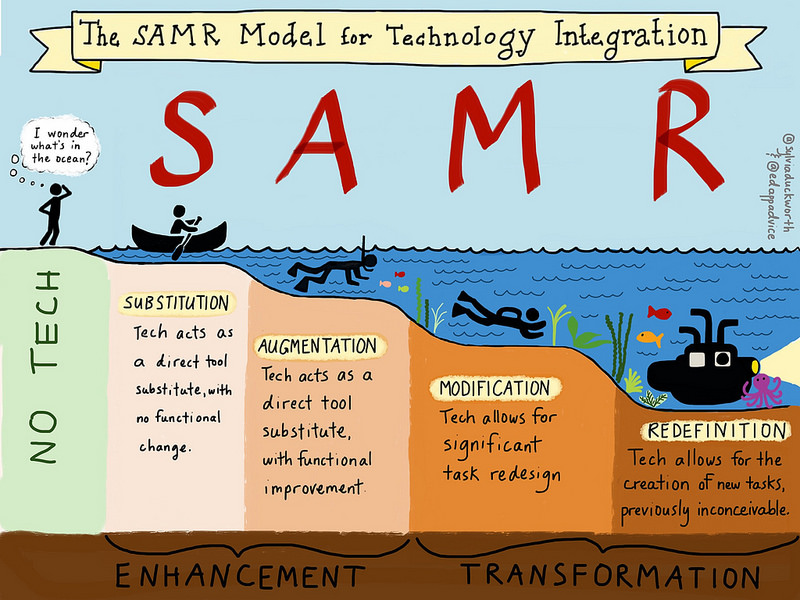
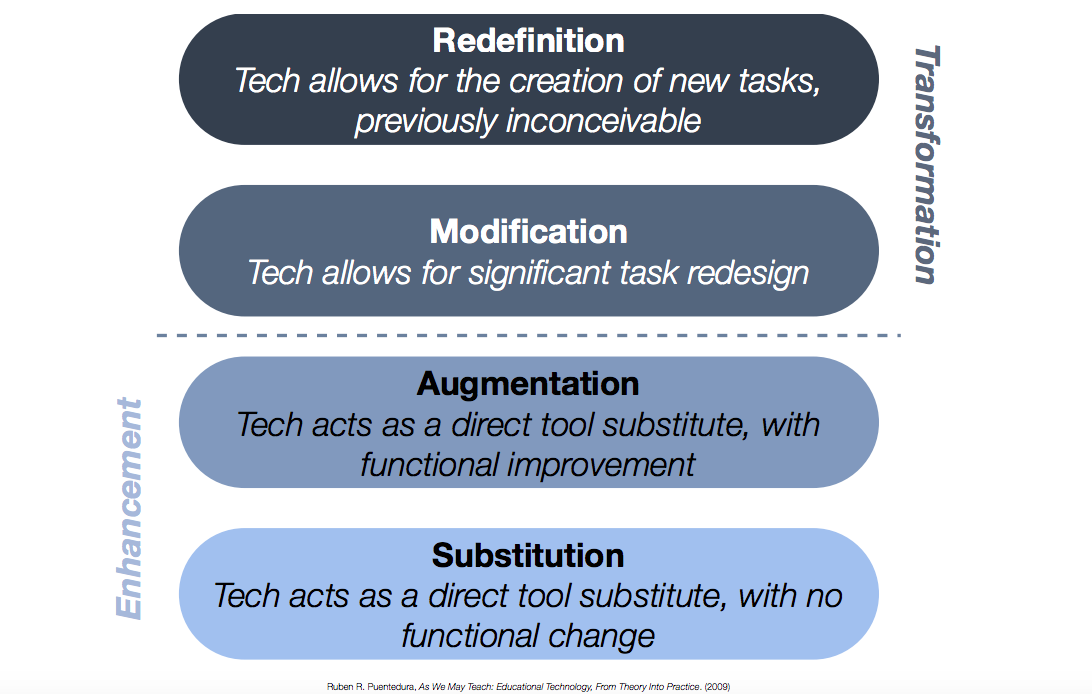
This lead me to have discussions with my peers. In this example of students in groups "learning, creating and sharing" you will see the use of hard materials to learn and share understanding. Digital affordances such as videos showing tutorials, and learning made rewindable through presentations are integral supports to our learn, create and share practice.
In guiding my students towards a learning goal together with trying to accelerate the rate in which they are learning, I have found that hard materials, captured digitally by students through photos and videos, shared digitally empowers the learner. It empowers them in that they can rewind and reflect on their learning well after small group work including hours outside 9am - 3pm.
In guiding my students towards a learning goal together with trying to accelerate the rate in which they are learning, I have found that hard materials, captured digitally by students through photos and videos, shared digitally empowers the learner. It empowers them in that they can rewind and reflect on their learning well after small group work including hours outside 9am - 3pm.
So check out some of our learners in Room 5. Here are Tape Measures group mapping out their thinking using pen and paper. Now it's also part of their learning, made rewindable on our class site. The engagement levels and progress made were sky high!!
Tuesday, 28 March 2017
Number knowledge framework - PD
Last weeks Maths PD by Jo Knox linked really well to what I am inquiring into in my CoL inquiry. To recap - my inquiry is looking into whether providing class time to learn and practice new knowledge will help students pick up/acquire the strategies faster. What I have tried to observe and look into while doing this inquiry is what barriers are preventing students from acquiring the necessary knowledge as they progress through their schooling years to reach us at Year 7&8.
Jo Knox clarified the progressive stages of development in number for our whole staff. This proved really useful especially when teachers are so used to just sticking to their area/stage they teach most of at their year level.
One of the main points I took out of the PD was clarity around stages 4, 5 and 6 and what it looks like. Jo presented this by showing a question and prompting us to think what would kids do if they were at stage 4, 5 & stage 6. What would it look like and what knowledge they need to know next in order to learn the next strategy.
Here are Jo Knox's slides which were very useful and can be used again and again to refresh and clarify what we are teaching our students.
Jo Knox clarified the progressive stages of development in number for our whole staff. This proved really useful especially when teachers are so used to just sticking to their area/stage they teach most of at their year level.
One of the main points I took out of the PD was clarity around stages 4, 5 and 6 and what it looks like. Jo presented this by showing a question and prompting us to think what would kids do if they were at stage 4, 5 & stage 6. What would it look like and what knowledge they need to know next in order to learn the next strategy.
Here are Jo Knox's slides which were very useful and can be used again and again to refresh and clarify what we are teaching our students.
Thursday, 9 February 2017
Teaching as Inquiry 2017
“Recognising and spreading sophisticated pedagogical practice across our community so that students learn in better and more powerful ways...”
The Manaiakalani Community of Learning is working together on this task using the expertise existing in of our community of learning.
In 2017 for my inquiry I have selected the following CoL achievement challenge:
#4. Increase the achievement of Years 1-10 learners, with a focus on Years 7-10, in maths, as measured against National Standards and agreed targets. My focus question is:
How can I accelerate students learning in maths through the teaching of number knowledge within a Learn, Create, Share pedagogy?
The elements in this framework share close similarities with other models New Zealand teachers use.

I will be labelling my posts as I update my inquiry throughout the year to make the content easy to access.
Labels:
LEvidence, LScan, LTrend, LHypothesise, LResearch, LReflect,
CPlan, CTry, CInnovate, CImplement, CReflect,
SPublish, SCoteach, SModel, SGuide, SFback, SReflect
Label Key:
LEvidence
|
Learn - Gather Evidence
|
CPlan
|
Create - Make a plan
|
SPublish
|
Share - Publish
|
LScan
|
Learn - Scan
|
CTry
|
Create - Try new things
|
SCoteach
|
Share - Co-teach
|
LTrend
|
Learn - Identify Trends
|
CInnovate
|
Create - Innovate
|
SModel
|
Share - Model
|
LHypothesise
|
Learn - Hypothesise
|
CImplement
|
Create - Implement
|
SGuide
|
Share - Guide
|
LResearch
|
Learn - Research
|
CReflect
|
Create - Reflect
|
SFback
|
Share - Feedback
|
LReflect
|
Learn - Reflect
|
SReflect
|
Share - Reflect
|
Subscribe to:
Posts (Atom)