Showing posts with label Preliminary findings. Show all posts

Wednesday, 12 May 2021

Preliminary Findings

 I started my data journey by analysing my target groups beginning of year STAR and PAT reading comprehension tests. I am always interested in find out raw scores (how many questions were actually answered correctly), the scale scores and stanines. Here are the results of my target group.


Unfortunately we had a technical glitch which didn't allow Student G1 to complete her test in order to generate a mark. 

One of the things I always find fascinating in analysing students test results is to look at their raw scores. How many questions our of the 37/38 questions in the test, did they actually get correct. As shown in the table above, only half the students managed to get more than 10 questions correct.

It's important to also note that the students whose test was out of 37 questions sat a slightly easier test that the rest who had 38 questions. This was because the students had already been identified as high needs in reading and writing in general. 

Another source of data gathering I conducted was collecting student voice. The list of questions and answers will be discussed in my next blog post.

My weekly reflections have been very useful. I have used my groups modelling books to take notes of vocab/attempts students have made as well as ideas being shared. This was to initially help with report writing comments coming up later in the term, but I've also found upon reflection that it works with my next steps for some students. 

One of the things which I didn't count on was having a student teacher. This meant I had 2 weeks of observing while she taught my classes. This gave me an opportunity to get some 1-1 time with my target learners, unpacking some of their thinking processes and ideas around school and reading in particular. This also will be discussed together with the student voice survey carried out.


Thursday, 30 April 2020

Preliminary Findings

TAI 2020 WFRC #4: Collecting evidence and data...

Begin to collect evidence and data and come to the next session ready to share your preliminary findings about the nature and extent of the student challenge i.e. using your baseline student data and evidence

One of my takeaways from CoL last year was to have a larger pool of target students. Depending on what your inquiry is, this is sometimes not ideal. However, in looking at my students data, I realise I can actually have a larger target group which give me more concrete data on whether interventions are working or not. 

Before we went into lockdown, I'd only just started collating data on my whole and had not actually informed students I would be tracking them. Therefore I also didn't get a chance to get student voice from Term 1. I am planning on sending out a google form to get student voice while we are still doing distance learning in Term 2.

Out of my 27 maths students, I'm selecting 22 as my pool of target students. They range from levels late year 3 to late year 6. Here are their OTJ's (Overall Teacher Judgements) from 2019 reports and this year 2020 PAT results analysis.
An overall view of how this particular group of students look using stanines is below.
Throughout this inquiry process, I am hoping to shift these bars to the right with a higher number of students achieving stanine 5 and higher.

Thursday, 2 May 2019

Preliminary findings - Part 2

This term I have continued my quest for collecting data and evidence (Preliminary findings - part 1) to show in clearer detail the nature or extent of the student challenge. 

One of the things I'd mentioned in the Tools, Measures and Approaches blog post was that I would seek help from CoL across schools teachers for more ideas on how I can get a clearer picture for what my target group CAN do. 
So in the holidays I booked a time with Donna Ryan from Sommerville Special School. I shared with her my struggles with pinpointing exactly what my students were struggling with in reading. One of the things she gave me was a spelling test which, when analysed, could give you a better idea if it is letter-sound problems, phonics or something else they are struggling with. Donna has also offered to come into my class in Week 2 this term to test these students and see if she can pick up any other learning behaviours I haven't been able to identify. 

The following are the spelling test for 7 out of 8 students. 1 of my students in this target group has been absent all week so far. This is a common pattern for him but I am still keen to keep him on as a target student.


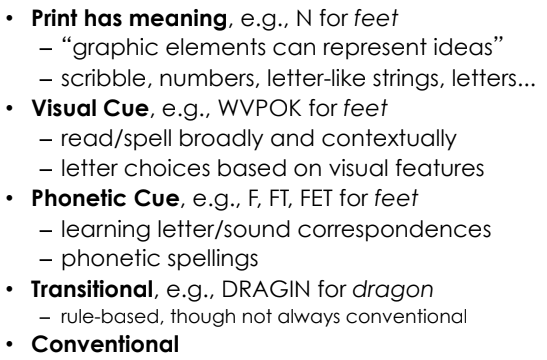
The different stages for this Development Spelling Word List (Ferroli & Shanahan 1987)
are below:
                              

Upon analysing this, I have an almost overwhelming feeling of helplessness for these students. I can't even begin to imagine how hard things must be for them in class, especially during whole class teaching, when they struggle to make connections between letters and sounds. This then moves onto putting letters (and sounds) together to form actual words.

Despite my feelings about this, this target group of students are quite up-beat about their learning. They are definitely enjoying the activities and realisation that learning can be fun! 

My next steps will be to see how the testing with Donna goes next week and go from there. Running records will also be starting soon and I'll be reporting on how that goes in a few weeks time.

Thursday, 11 April 2019

Preliminary findings

As we come to the end of Term 1, I've started collecting some baseline data and evidence of the nature or extent of the student challenge. My previous post shared the tools and approaches I'd planned to use so here are my preliminary findings.

1. HFW Test - This test was conducted 1-1 and consisted of 77 words from Magenta reading level to Orange (Level 15). Students simply read each word going across the page. I tried to note down just like running records their attempts and self-corrections during the test. Here is what the test looks like.

Here are the test results of all 8 students.
A few of the students felt very frustrated as they recognised some of the words as words they've read before but on its own, they couldn't pinpoint what the actual word was. The showed me that they knew the patterns or sentence structures used in the texts they read that they were not paying attention to the actual letters forming the word, but rather "oh 'where' is normally the start of the sentence when they are looking for something". They only look as far as the first letter, then start guessing all the words they know that start with that letter.

2. Student Voice Survey - I conducted this as a group as they needed a lot of help to understand the questions as well as someone to record their answers. This also helped as they were giving each other ideas which they wouldn't be able to get on their own. Here are their responses.
I could tell by their excitement and rush to tell me more, that they felt quite important being asked what they thought of their reading lessons. I need to remember to do this more often so they can see the value of their learning and teachers actually wanting their input into how they learn in reading and writing time.

3. Weekly Reflections and Observations - This was normally jotted down onto whatever piece of paper I had lying around then put into my diary for a later date. So far I have a diary full of reflections based on just this group alone. Here is a summary of my reflections in term 1.